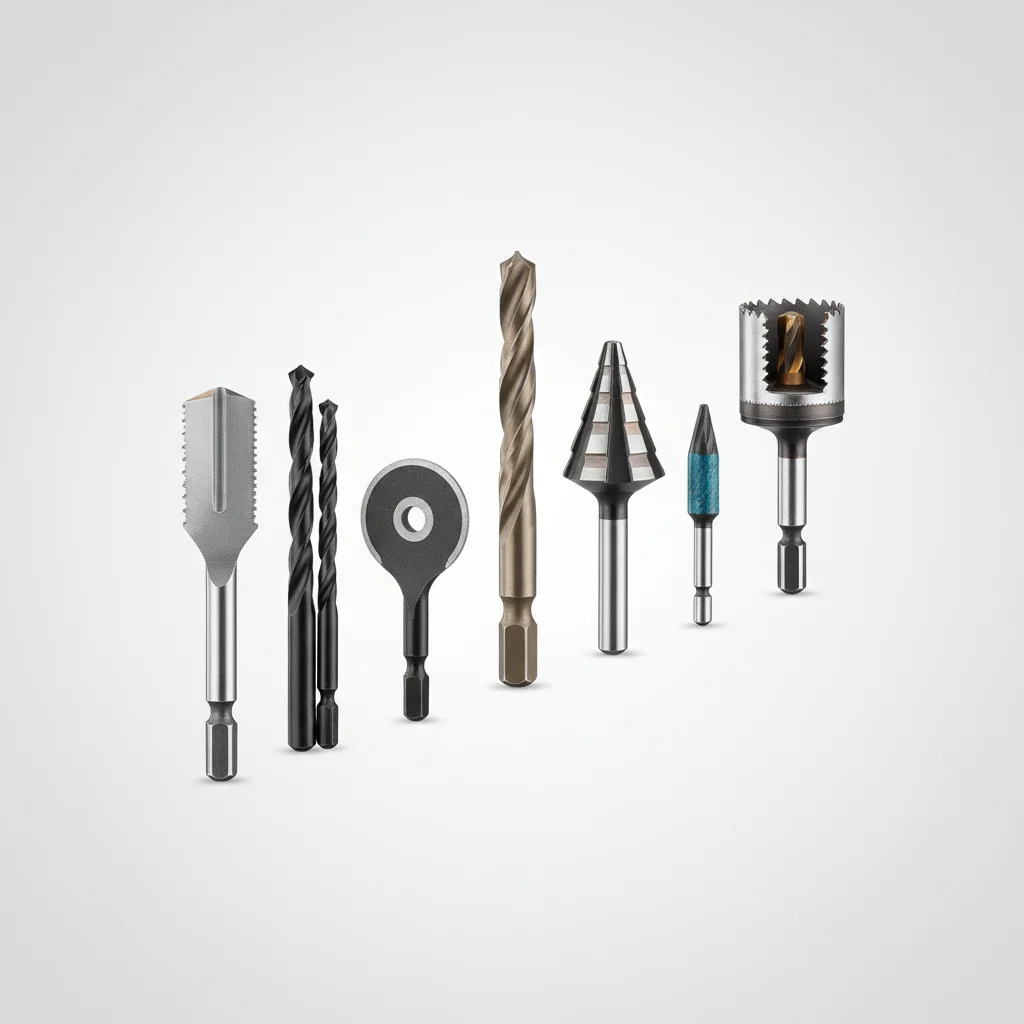
Electric drill bits are the unsung heroes of any drilling task, transforming your power tool into a versatile workhorse. Understanding the different types of bits available is crucial for achieving clean, precise holes and preventing damage to both your material and your drill. There are seven essential types of electric drill bits that every DIYer and professional should be familiar with, each designed for specific materials and applications.
Twist Drill Bits: The All-Rounders
Twist drill bits are the most common and versatile type, recognizable by their helical flutes that remove chips from the hole. They are excellent for general-purpose drilling in wood, plastic, and soft metals. Available in high-speed steel (HSS) for basic tasks and cobalt or titanium-coated for increased durability and heat resistance when working with harder materials, twist bits are a staple in any toolbox. Their pointed tip allows for easy centering and a clean start to most drilling operations.
Brad-Point Drill Bits: Precision for Wood
When working with wood, brad-point drill bits are indispensable for their ability to create exceptionally clean and splinter-free holes. These bits feature a sharp, central point that precisely locates the hole, preventing the bit from wandering. Two spurs on either side of the point score the wood fibers before the main cutting edges remove material, resulting in a smooth-walled hole ideal for doweling, joinery, and other fine woodworking applications. They are particularly effective in preventing tear-out on the exit side of the material.
Spade Drill Bits: Fast and Wide Holes in Wood
For quickly drilling larger diameter holes in wood, spade drill bits are the go-to choice. Their flat, paddle-like design with a sharp point and cutting edges allows them to remove a significant amount of material with each rotation. While they may not produce the cleanest holes compared to brad-point bits, their speed and efficiency make them perfect for rough carpentry, creating holes for pipes, wiring, or other utility installations. They are typically used in applications where a perfectly smooth finish is not the primary concern.
Masonry Drill Bits: Conquering Concrete and Brick
|
Our Picks for the Best Electric Drill in 2026
As an Amazon Associate I earn from qualifying purchases.
|
||
| Num | Product | Action |
|---|---|---|
| 1 | FADAKWALT Cordless Drill Set,12V Power Drill Set with Battery and Charger, Electric Driver/Drill Bits, 3/8'' Keyless Chuck,21+1 Torque Setting, 180 inch-lbs, with LED Electric Drill Set (Green) |

|
| 2 | DEWALT 20V Max Cordless Drill Driver Set, 2 Speed, High Performance Motor, Includes 2 XR 1.3Ah Li-Ion Batteries, Charger and Contractor Bag (DCD771C2) |
|
| 3 | AVID POWER 20V MAX Lithium lon Cordless Drill Set, Power Drill Kit with Battery and Charger, 3/8-Inch Keyless Chuck, Variable Speed, 16 Position and 22pcs Drill Bits (Red) |
|
| 4 | 20V Cordless Drill, Electric Power Drill Set with Battery Charger and Carrying Case, 3/8” Keyless Chuck, 2 Variable Speed, 18+3 Torque, 72pcs Driver Bits and Belt Hook, Red |
|
| 5 | Cordless Drill Set, VIWKO 20V Power Drill with Power Pack 2.0Ah and Charger, 3/8-Inch Keyless Chuck Electricdrill, 25+1 Torque, 42pcs Drilldriver Bits/Screws for DIY Projects (Red) |
|
| 6 | DEWALT 20V MAX Cordless Drill Driver Set, Electric Drill, Brushless 1/2 In 2 Speed, 2.0 Ah Battery and Charger Included, LED Light (DCD777D1) |
|
| 7 | BLACK+DECKER 20V MAX* POWERCONNECT Cordless Drill Driver Kit with Drill Bit Set and Sockets, 100 pc. Tool Kit for Home, Battery and Charger Included ,Orange (BDC120VA100) |
|
| 8 | Hoteche 320W 10mm Torque Drill, 19+1 Torque Settings Corded Electric Drill for Metal (10mm) & Wood (20mm), Yellow, Color Box Packaging |
|
| 9 | PULITUO'S 20V Cordless Drill/Driver, Electric Screwdriver - 2 Batteries, 30Nm, 21+1 Torque, 2 Speed, Keyless 3/8" Chase Drill with LED Light, Kit for Home (Green) |
|
| 10 | COMOWARE 20V Cordless Drill, Electric Power Drill Set with 1 Battery & Charger, 3/8” Keyless Chuck, 2 Variable Speed, 266 In-lb Torque, 25+1 Position and 34pcs Drill/Driver Bits |
|
Masonry drill bits are specifically designed to tackle tough materials like concrete, brick, mortar, and stone. They feature a carbide tip brazed onto a steel shank, which provides the necessary hardness and impact resistance to chip away at these abrasive surfaces. These bits are often used with hammer drills, which provide a percussive action in addition to rotation, significantly speeding up the drilling process in masonry. Always ensure you are using the correct size and type for the specific masonry material to avoid damage to the bit or the surface.
- Carbide-tipped for durability in hard materials.
- Designed for use with hammer drills for optimal performance.
- Available in various lengths and diameters for different tasks.
- Essential for mounting fixtures or running conduits through walls.
- Requires a firm grip and steady pressure during use.
Forstner Drill Bits: Flat-Bottomed and Overlapping Holes
Forstner drill bits are unique for their ability to create flat-bottomed, clean holes in wood, as well as overlapping holes. They feature a central point for accurate positioning and a circular rim with cutting edges that shear the wood fibers. This design makes them ideal for creating precise recesses for hinges, dowels, or other hardware where a flat base is required. They are also excellent for boring partial holes or for creating intricate patterns by overlapping cuts, offering a level of precision unmatched by other wood bits.
Hole Saws: Large Diameter Cuts
When you need to cut very large diameter holes in wood, plastic, drywall, or even some metals, hole saws are the answer. These bits consist of a cylindrical saw blade with teeth, attached to a mandrel that fits into your drill chuck. A pilot bit in the center guides the cut, ensuring accuracy. Hole saws are commonly used for installing recessed lighting, creating openings for plumbing, or cutting access holes. They come in a wide range of diameters, making them incredibly versatile for various construction and DIY projects.
Auger Drill Bits: Deep and Clean Holes in Wood
Auger drill bits are specialized for drilling deep, clean holes in wood, particularly in timbers and logs. They feature a screw-tip that pulls the bit into the material, reducing the effort required from the user. The wide, single-spur cutting edge and large flutes efficiently clear chips, preventing clogging even in deep holes. These bits are often used in timber framing, post-hole drilling, or any application where deep, precise holes in thick wood are necessary. Their robust construction ensures durability and consistent performance in demanding woodworking tasks.
Get our weekly buyer guide
Practical specs, not advice. Unsubscribe anytime.
